9.10.12

Market Forces. Gentrification, Regeneration or Degeneration?


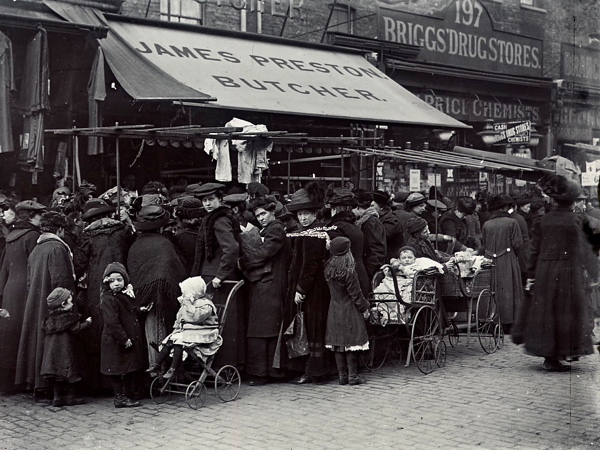
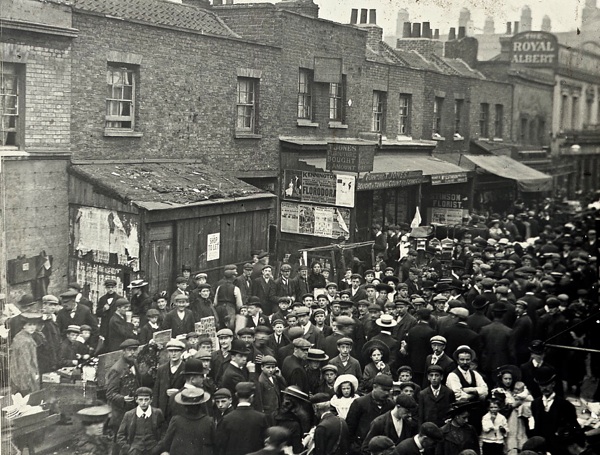
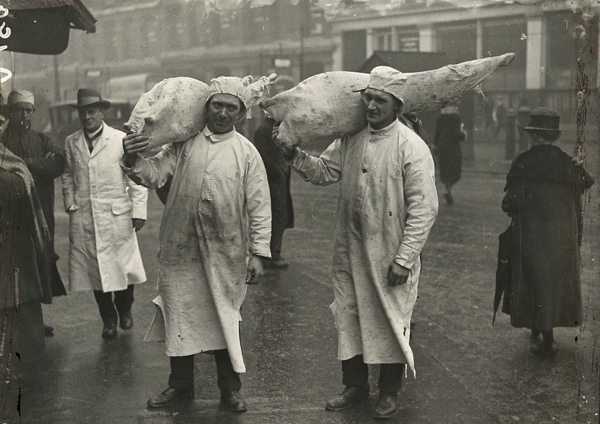
Hoxton Market, Shoreditch, 1910/ East St Market, c.1910/ Porters at Smithfield Market, c.1910. Photographies © Spitalfields Life 2009-12


Broadway Market is located in East-End London, in the Borough of Hackney. Barrow boys have been welcoming shoppers to Broadway market since the 1890s. It is one of London's oldest market located on the ancient drover's road from Essex to the slaughterhouses of Smithfield. This busy food  market dwindled over time until it was limited to a couple of stalls in the early 2000s.  It has been revived on 8 May 2004 when a  food market was launched on Saturdays.  The ongoing development of the area has sparkled a debate about the perceived gentrifiction of Hackney, the greed of some 2012 Olympics game developers and the dubious way a couple of ancient tenants of shops have been evicted from their small premises like Tony Francesca or Spirit. 
"Regeneration sounds like one of those unproblematically good ideas. It is a term you hear a lot from government ministers. One imagines love and attention being poured into a neglected place. But, as Patrick, one of the people who took over Francesca's, puts it, "when local people hear the word, they feel afraid. They feel attacked." The arrival of money into an area always leaves winners and losers, but the more I discover about what has really been happening here, the more I have come to feel angry about the callous way in which the process is being handled. Is this regeneration or degeneration?"
Some people are pessismistic and wonder if landlords will eventually drive the independents out and replace them with franchises.
To know more about the issue, you might be interested by Hari Kunzru's article in The Guardian. I could not find any more recent article on what happened to Tony Francesca's café but I understand from what I read in The voluptuous manifesto that it just disappeared. I would be interested to learn more about it. I am going to investigate further and let you know if I can find something. May be you know better about it? 
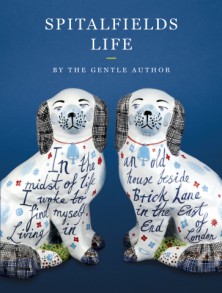
The photographs of old markets of London come from a very special blog - which is much more than a blog and has also become a book.  Spitalfields life is signed by the genteel author who tramp the streets of East-end London in search of simple daily life treasures. I have just begun ramaging through it and I cannot but strongly recommend it to you. Next time I will tell you more about Mr Pickleman (photo 4).


8.10.12

A New Frontier Myth. In Search of East End...


Lire et écrire la ville


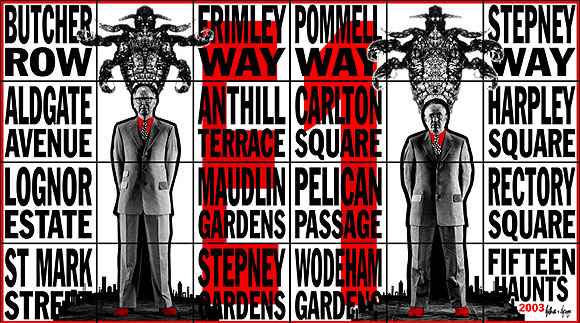
Forty locations, Fifteen haunts and Seventeen streets
  © Gilbert and George, Musée d'art moderne Saint-Etienne, avril 2005 
 All other photos © Jattends


It would not be easy today to find some hopeless conservative using the term East End as a pejorative word, associated with the stigma of poverty, foreign immigration and violence. It is now difficult to imagine how remote the East End of London must have seemed in the late 1960s. "The cultural uptake of the Hoxton scene – as a highly potent image of newness, hipness and fashionability – by the mainstream of not only the art establishment, but the worlds of media, advertising, fashion, design and property development was extraordinarily rapid.(...) In fact, to the social anthropologists at work in advertising agencies and market research offices, the word "Hoxton" was both noun and adjective. This old London district became the latest shorthand to denote what trend analysts have officially described as "urban edgy" – meaning the new, monied, inner-city consumers for whom a knowledge of contemporary art would be right up there with their aspirations for a Thameside loft apartment, a holiday in a hip hotel and their fondness for Pret A Manger sandwiches."
The new bohemia of the British contemporary art scene is now firmly settled in E1. Many artists from the YBA (Young British Artists) live and work in the area. Tracey Emin has her home in Fournier Street, Gilbert and George have been resident there since 1965. "They had been attracted to the East End not simply by the affordability of property – much of it formerly industrial, or almost wholly derelict – but also by the need to declare a barrier of sensibility between themselves and the prevailing cultural climate. "* 
Where is the new barrier of sensibibility and the new frontier to be found now ?


*Michael Bracewell, Gilbert & George - true pionneers of East end art, The Telegraph, 31 mai 2004


1.10.12

The Drama of Victorian Life. Pré-Raphaelites: British Avant-Garde?


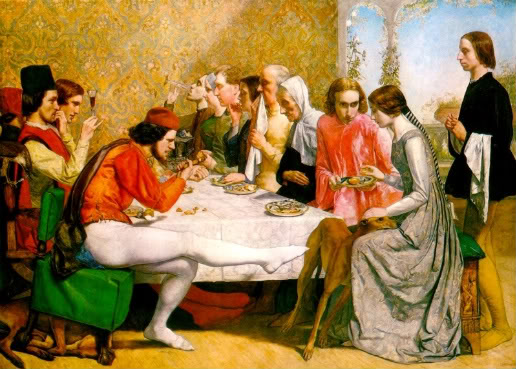
1&6  Dante Gabriel Rosetti, Lady Lilith, 1866-68, Delaware Art Museum, details
2 Salvador Dali, Mae West sofa
3 William Morris' bed, Kelmscott Manor
4 Tracey Emin, My  bed, 1998
5  Isabella,  John Everett Millais,  103 cm x 142.8 cm, Walker Art Gallery Liverpool


"Tate Britain's new Pre-Raphaelites exhibition is a steam-punk triumph, a raw and rollicking resurrection of the attitudes, ideas and passions of our engineering, imperialist, industrialist, capitalist and novel-writing ancestors. The pistons are pounding, the steam is hissing, cigars are being lit and secret lives once more being concealed. The Victorians are back in town. This is as much a costume drama as a show, jam-packed with heroes and villains and innocent victims, holding up a lurid mirror to the age that built Britain.
As is the way with costume dramas, it is at once delightful and a bit silly. It delights because the curators really believe in the artistic brilliance of the "Brotherhood" and that enthusiasm is infectious. The silliness is inherent in Pre-Raphaelite art, which has some of the relentlessness of a speech by William Gladstone and the timebound detail of a condition-of-England novel by Benjamin Disraeli. You can't have everything."
This is how Jonathan Jones, journalist at the Guardian chose to begin his review of the Tate Britain's massive exhibition on Pre-Raphaelites. It is not enough to say that the British intelligentsia is rather of two minds about this aesthetic movement, many  critics and intellectuals take it for granted that they have to sneer at it.
The exhibit seems to aim for comprehensiveness. It brings together over 150 works in different media, including painting, sculpture, photography and the applied arts and you need to allow at least three hours to make sure you can see it properly. For its curators  the Pre-Raphaelites constitute Britain’s first modern art movement and they want to establish the PRB (Pre-Raph Brotherhood) as an early example of the avant-garde: painters who self-consciously overturned orthodoxy and established a new benchmark for modern painting and design. Their art bursts with sexuality and social critique. They  stage  such a bold and lurid revelation of the secret and lies of the Victorian age that their reliance in some complacent artistic formulae can be easily  forgiven as the flaw of a young and talented band of radicals.

Les Préraphaélites sont-ils une avant-garde? Telle est la question que se posent les commissaires de l'exposition organisée par la Tate Britain en l'honneur de ce mouvement tour à tour décrié ou adulé. Un accrochage dense, de plus de 150 oeuvres dans différents média, dont certaines n'ont encore été que très peu montrées cherche à mettre en avant le contexte historique. Il est de bon ton Outre-Manche, parmi une certaine intelligentsia, de se moquer de cette esthétique dont on souligne les tics et abus de formules et une certaine forme de pédanterie empesée. Est-on sûr qu'on comprenne bien aujourd'hui leur langage, ces petits miracles de fictions qui dénoncent avec une violence décapante et ironique les vices et les vertus de l'ère victorienne? Dispose-t-on encore des clés de lecture pour comprendre toute la force de leur radicalité anticonformiste? On peut au moins admettre que les commissaires d'exposition ont réussi à mettre en lumière les contradictions et opacités de cet âge victorien fascinant, si populaire et cependant méconnu.  


Pre-Raphaelites: Victorian Avant-Garde


Tate Britain: Exhibition
12 September 2012 – 13 January 2013


J'ai pu couper ma visite par une pause thé au café du musée. Le cream tea est parfait, les scones sont vraiment délicieux, clotted cream et confiture Fortnum and Mason, pour un prix vraiment modique. La décoration n'est pas à la hauteur mais des travaux sont prévus. 

For those interesting in  the Pre-Raphaelite circle, see Jan Marsh's site. She is a biographer and wrote extensively on the period. Pre-raphaelite sisterhood blog might also be instrumental.