Showing posts with label Visual Arts. Show all posts

13.5.12

Unconscious (2) The Visible and the Concealed In Markus Schinwald's Portraits


carcan


  • 1.  Collier de fer fixé à un poteau pour y attacher un condamné. La peine du carcan a été   supprimée en 1832.
    Une femme cria fort haut ; les archers la saisirent et la mirent indiscrètement à un carcan voisin. [Saint-simon,Mémoires complets et authentiques du duc de Saint-Simon]

  • 2.  Sorte de collier de bois qu'on met aux cochons pour les empêcher de se frayer passage à travers les haies.

  • 3.  Sorte de collier de pierreries.
    Ces riches carcans, ces colliers Et cette pompe enchanteresse Ne valent pas un des baisers Que tu donnais dans ta jeunesse. [VoltairePoèmes et épîtres]

    Dictionnaire de la langue française  Littré

Austrian artist Markus Schinwald represented the Austrian pavilion at the last Venice Biennale with an installation where he transformed the spatial experience of the visitor by creating elements of disturbance and discomfort. Manipulating portraits from the end of the 19th century by intervening on the face, or on some part of the body, he explores the scars of repression and the latent energy of the repressed to "give sociopolitical visibility to the inscrutable." His installation aimed at altering the visitor's perception in order to provoke disturbance and distraction. His first solo exhibition in France at the Gallery Yvon Lambert showed an enormous three dimensional structure with impassable narrow corridors impeding the vision of some of his works. Playing with the notions of the visible and the concealed he provokes our trouble by challenging us to question the  irrational depth of our individual and collective existence.


 1, 2, 3 & 5 Markus Schinwald, © Collection Fondation Francès
4 Gallery Yvon Lambert


Markus Schinwald est un des artistes de la collection permanente de la fondation Francès. Ses portraits sont actuellement exposés dans une exposition dialogue avec l'artiste invité, Philip Gurrey.

« Stigmates » à la Fondation Francès de Senlis jusqu’au 9 juin 2012


Fondation Francès
27 rue St Pierre
60300 SENLIS


1.5.12

Cabinet of Wonder (3) "House of Beasts" Confronting Otherness at Attingham Park


Jones's Views of the Seats of Noblemen and Gentlemen (1829)


 Lady Berwick 

 by Sir Gerald Festus Kelly


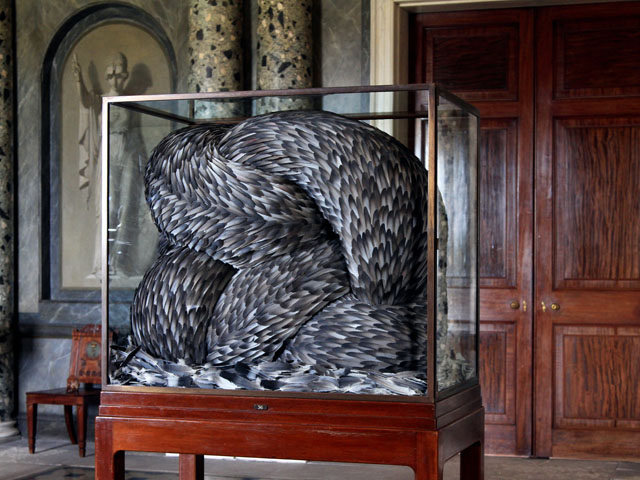
Kate MccGwire, Evacuate, 2010 Photo: Jonty Wilde


Kate MccGwire, Vex, 2010


Alastair Mackie, Sphere, 2003 


"House of Beasts" is a new exhibition set within the surroundings of Attingham Park in Shropshire. Meadow arts in partnership with the National Trust chose to show over thirty contemporary work of arts directly inspired by the history of the place or responding to its rich collections. The work of the selected artists (about twenty, among which Polly Morgan, Kate MccGwire, Alastair Mackie,  Tessa Farmer...) highlights the importance of our relationship to animals, wild or domestic and the ambiguity of the feelings and emotions involved. All of them play with the historicism of the mansion, sometimes focusing on the "behind the scenes" and  the repressed.  
Exploring alternative taxidermy, Alastair Mackie creates  spheres out of mouse skulls, panels out of wasp heads and fabrik out of owl silk. To create his sculpture he extracted mouse skulls from the pellets regurgitated by owls. "With meticulous craftsmanship he turns this natural product into an object of fascination, beauty and scientific curiosity. A hint of the initial violence lingers in the fragility of the work."  Kate MccGwire invents uncanny creatures with thousands of locally sourced bird feathers, each taken from a species regurlarly cooked in the kitchen. Her feathers hybrids defie the naturalist's attempts at categorization. "Half bird, half snake, it lies somewhere between a creature of myth, an extinct beast and a corporeal representation of the angst-ridden contortions of the human subconscious." 

2 july 2011- 15 JULY 2012


26.4.12

Bestiary(4) L'étrange et le merveilleux de Denis Polge


Série Animals


Série Fetish


S’il est au sens classique du terme un sculpteur animalier – allant jusqu’à fondre dans le bronze comme Barye, Pompon ou Flanagan taupe et mulot -, quand le plus gros du bestiaire fait l’éloge de la collecte des matériaux et du bricolage, il ne peint qu’en de rares occasions des animaux à plume sauf quand il chasse sur les terres des Primitifs italiens. De cet amour, il dit : Vivent les animaux à poils, à panaches (sauf les autruches)! Tout ce qui a du pelage et de la moire de plume. Tout ce qui appelle à être touché du regard, c'est-à-dire non touché. Tout ce qui procure une jouissance ou sa frustration, sa retenue… du pubis et de la couleur.


Il ajoute : Oui il y a du plaisir en même temps que de la frustration... Mais c'est très bien comme ça. La frustration c'est ce qui permet de renouveler le plaisir. Et ce qui le préserve d'être consommé; ou ce qui lui permet d'être consommé à nouveau sans en être jamais rassasié... 
Il déclare aimer : Les oiseaux aux pieds de Saint-François, les pigeons et les coqs qui sont plus merveilleux que les paons. Les chèvres de Giotto. Mais j’aime aussi les papiers de bonbons, les scories des trottoirs (Paris est plein de pétales entre les coulures de pisse). Et les fleurs de courge*.
*Ecrits de Denis Polge, Lagnes, octobre 2010, correspondance avec l’auteur. 
Xavier Girard, Fragments de paradis. Extrait.


Animal Fétiche

Il les appelle ses petits objets votifs, ses attrape-cauchemars. De quels fantasmes sont-ils les leurres? De quel fonds sont-ils l'inventaire? De quelles scories et reliquats de l'âme sont-ils la conjuration? Entre jouissance et frustration, ils se tiennent sur le territoire hésitant de la psyché enfantine mêlant innocence et culpabilité. Qu'ils disent le malaise de pulsions primitives, qu'ils soient les vestiges de petits meurtres ou de petites prières instantes, ils interrogent l'essence même de notre civilisation*. J'éprouve un frisson de curiosité à l'idée de peut-être un jour pousser la porte de cet atelier. 


Denis Polge, Fragments de paradis,  texte de Xavier Girard. La Pionnière, 2010
Denis Polge, Autres Rives,  textes de Xavier Girard et Henry Mathieu. Le Promeneur,Gallimard, 2009
Denis Polge, Les Eaux Dormantes,  textes de Patrick Mauriès, François-Xavier Lalanne, Richard Stamelman, Henry Mathieu. Le Promeneur, Gallimard 2007


Denis Polge est un des artistes de la Galerie F. de Nobele, 2 rue  de Bourbon Le Château , Paris VI


*Freud,  Malaise dans la civilisation, 1930


16.4.12

Un peu de douceur. Le petit monde de Yumiko Froehlich


Par delà la petite porte


L’autre jour, j’ai découvert une petite porte dans un coin de ma chambre.
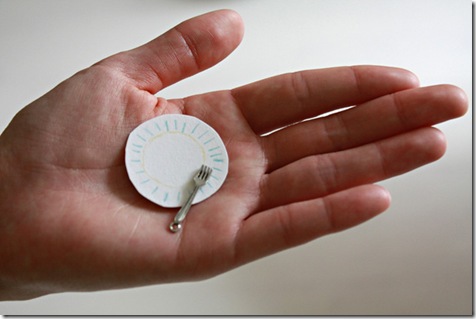
Je me suis approchée et il y avait une minuscule famille en train de prendre le thé !
Ils avaient l’air contents de me rencontrer. J’ai même reçu un petit morceau de gâteau au fromage.
Ce matin,  je suis retournée voir dans le coin, mais la porte n’y était plus ! Avais-je donc rêvé ?
Mais dans ce cas, d’où viennent la petite fourchette et l’assiette en carton ?


Aujourd'hui j'ai découvert le blog de cette jeune artiste japonaise  installée à Paris et j'ai tant été sous le charme que je l'ai parcouru en entier comme un album. Il y a des histoires faites avec presque rien. Régression totale, j'avais cinq ans, peut-être moins et j'ai ressenti le même frisson que j'avais oublié et que je me suis rappelée quand je jouais, cachée dans un placard, à me raconter des histoires  avec de minuscules poupées de paille. Pour entrer dans son blog, c'est par ici, Yumiko Froehlich


 ©2012 Yumiko Froehlich

10.3.12

Cabinet of Wonder (2) Kate Mac Dowell's Porcelain Artefacts


Ants ate all my sugar


Bad Seed 


God of Change 
All rights reserved © Kate Mac Dowell

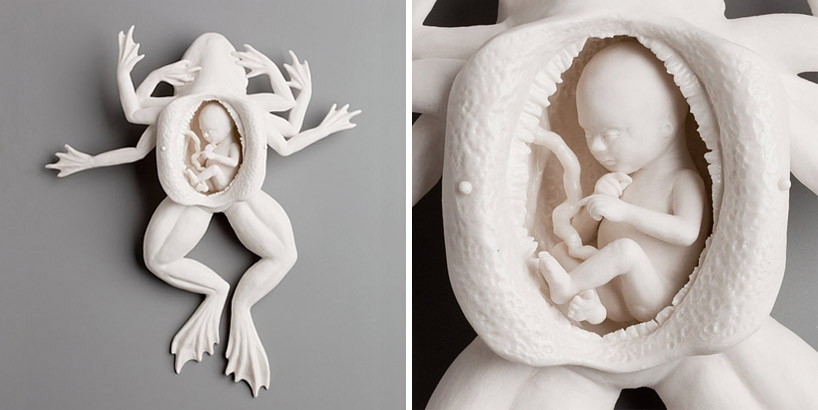
Visual Artist Kate Mac Dowell, of Portland, Oregon USA depicts a world of unsettling conflicts between our romantic ideal of union with nature and our contemporary impact on the environment.   She hand sculpts each piece out of porcelain, after building a solid form and then hollowing it out. "A piece also speaks to me of ghosts or negative space. It suggests something missing in the world," she says.  She sees each piece as a captured and preserved specimen, a painstaking record of endangered natural forms , a commentary on our own culpability. " I chose porcelain for its luminous and ghostly qualities,  it highlights both the impermanence and fragility of natural forms in a dying ecosystem." Her  exquisite detailed narratives draw upon the Italian baroque, the classical mythology and metaphysical poems of Oliver Cromwell's time as well as references to the kitsch defined by Odd Nerdrum.  To know more about her, I recommend the interview by Lobster and Canary and her website Kate Mac Dowell.

Galerie Vanessa Quang, 5bis, rue de Beauce 75003 Paris
Bo Lee Gallery, Queen Street, Bath, BA1 1 HE, UK 

23.2.12

Tenka Gammelgaard's World in Black and Light


Tenka Gammelgaard's studio   


Plates for Royal Copenhagen


Hanging books


I could spend hours and hours roaming through Danish artist Tenka Gammelgaard's visual inspiration diary. It gives me the same feeling of deep knowledge and empathy we can have with  authors we are deeply familiar with.  All the pictures above are taken from Tenka Gammelgard's  blog.

18.2.12

Yayoi Kusama's Obsessions


Yayoi Kusama's " The obliteration room" 2011 GOMA Queensland, Australia 

I am happy to participate in Yayoi Kusama's interactive project "The obliteration room" by re-blogging the installation; those millions of posts oblitering the net like so many dots! There are currently two major exhibitions of Yayoi Kusama's work, one at Queensland Gallery GOMA in Australia, "Look now, see forever" and one at the Tate Gallery, London until 5 June 2012.