Showing posts with label London. Show all posts

9.5.14

Classic with a Twist. Into Paul Smith's Head


Everyday is a new beginning

Paul Smith


An ode to Instability and Movement


For  Sir Paul Smith, inspiration is everywhere and you can find inspiration in everything. The key point is how you SEE and play around with what you can see. His mind seems endlessly busy with the game, making unexpected connections, reworking the traditions with a contemporary edge, breaking the rules. Since he was 11,  when his father- a photographer in Nottingham, offered him his first camera, he never ceased to take pictures, using his shots as a day to day notebook. I like the way he reworked an engraving of a Victorian rose using the input of Kinetic art to convey an idea of instability, movement and adaptability. Adaptability might be the first of his top ten qualities and the secret of his timeless success. Generosity would come second undoubtedly. 


Hello my name is Paul Smith 


London

15 November 2013- 22 June 2014


1, 5 Photographs from  Hello my name is Paul Smith
2, 3 Photographs via Le Divan Fumoir Bohémien, Le travail de la rose
4, 6 Pol Bury, La Tour Eiffel, Le cycliste, cinétisations photographiques


5.1.14

Idioms, Phrases and Moral Tales. Rory Dobner's Intricate World of Ink


a fly on the wall(idiom)someone who can secretly see 
and hear what happens 


English illustrator Rory Dobner lives and works in beautiful Hampstead. Gambling addict foxes, gun-toting octopuses, cupcake-eating lizards, traveling mouses with umbrella, smoking fish,  geyhounds with shabby top hats and chains, crowned bees are just a few of the quirky characters he is turning out of his whimsical imaginative world. No wonder he answered he would be a Victorian magician  - when asked by Life.style.etc what he would be in another life.


Links: Sanctuary and Liberty


18.11.13

To the Unknown Friends. Kaori Tatebayashi's World of Clay


To Ink


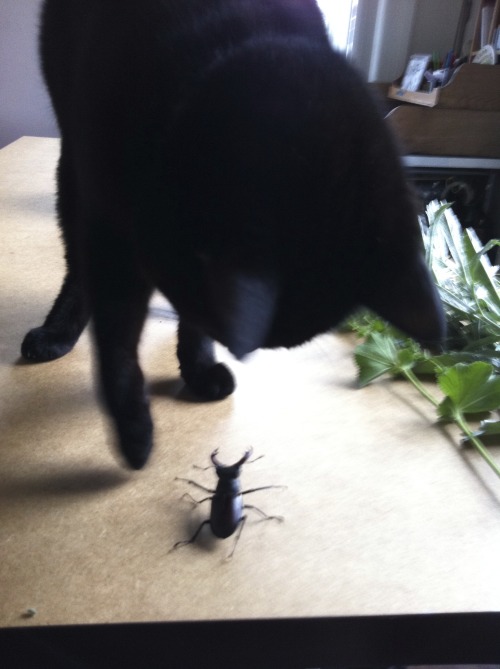
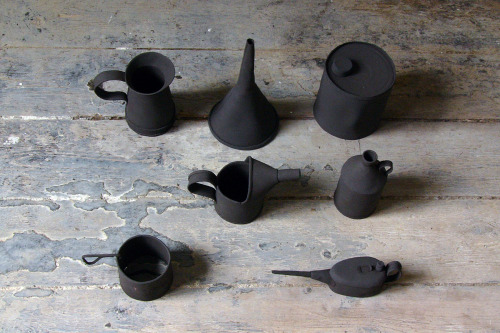
Kaori Tatebayashi grew up in the Japanese village of Arita famous for its Imari ware. As a child, she spent a great deal of time playing in the pottery factory of her relatives. She breathed the atmosphere of ceramics making mesmerized by the work of the craftsmen. I imagine her sitting near the potter's wheel, silent as a cat, unobserved and totally absorbed in the assimilation of all she could sense. Her work is fed by the thousand details of her daily life in South London - a squirrel paying a visit to her Austin roses, her black cat sniffing a stag beetle, a black bird filling his chubby cheecks with grains, baby pigeons playing hide and seek in the dusk. Nature is omnipresent in her work. Creating her pieces of clay is a way for her to encapsulate and to transform the memory of her chidhood landscapes. She explains how the pattern of Kage plate, named after the Japanese word shadow was inspired by the silhouette of a plant. Similarly, the edges of Kumo series resemble mountain ridges. Browsing through the pages of her Tumblr is like being admitted to have a  peek at her sketchbook, to share some of her inner world and harmony power. To me it is an endless source of joy and meditation. It is like tasting the essence of Japanese Spring.   


 Photographs © Kaori Tatebayashi


11.10.12

Cycling up. Jamesplumb: Furniture Narratives and Hybrid Symbolism


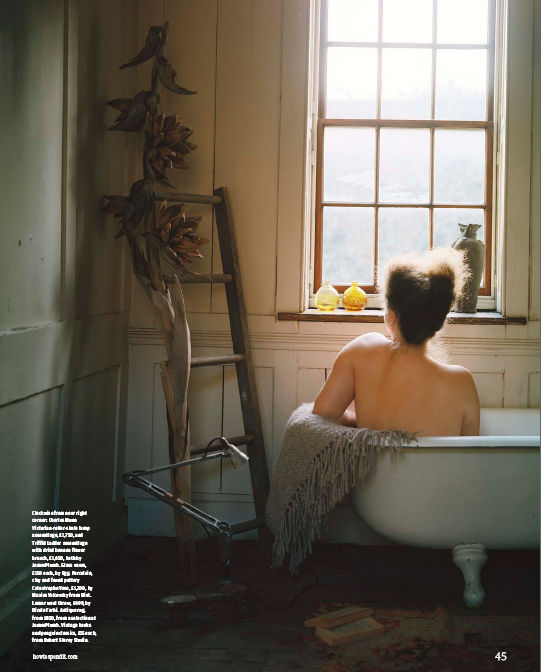
1 Triffid Ladder, an antique dried flower replaces the leg of a neglected old wooden ladder.
2&9 For Richer for Poorer from the Concrete Stitches series - broken and abandoned furniture is rendered functional again by casting concrete in, on, and around the pieces.
3&4 From this day forward, Movable interior, April 2010, Milan
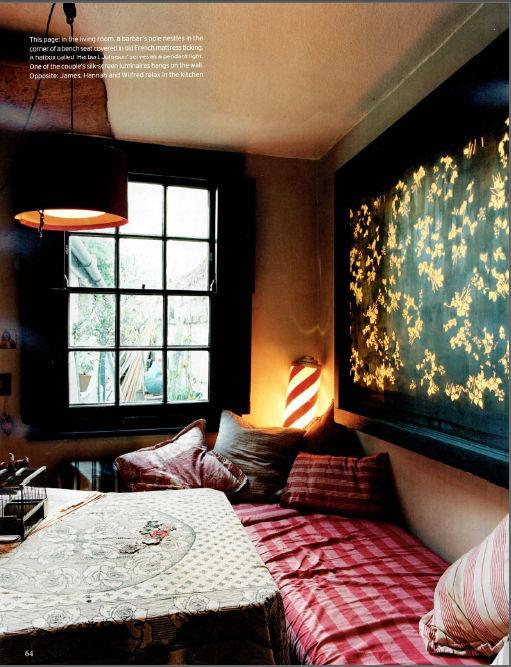
5&6 The duo's interior in World of interiors, July 2010 
7 Portrait of James Russell and Anna Plumb by Andrew Meredith Photographer for Elle decor Italia


JAMESPLUMB is a design duo of British designers headed by two artists under one name, James Russell and Anna Plumb. The designers salvage forgotten treasures and lovingly restore them, giving them a new life and a new function. Curiously, the ethos of the duo is inscribed at the heart of their made up name, created from a hybridation of their two names. They use the same fusion process in their creations, celebrating the union of two seperate objects, eventually becoming one. The symbolism of marriage narratives is suggested in the name of their Concrete Stitches collection, 'For Better or Worse', 'Richer the Poorer', 'Until Death Do us Part'. The duo is a couple in life. Do they reassert their pledge of mutual support and love by inventing new narratives together, fighting against the erosion of time and menace of decay?
The overlooked, discarded and time-worn find  a new identity and  a new story under their hands. New tales that might have gone untold reveal the  victory of love and hope over death.

They had their first international exhibition From This Day Forward curated by Diana Marrone for the Fuorisalone during Milan Design Week 2010.  


9.10.12

Market Forces. Gentrification, Regeneration or Degeneration?


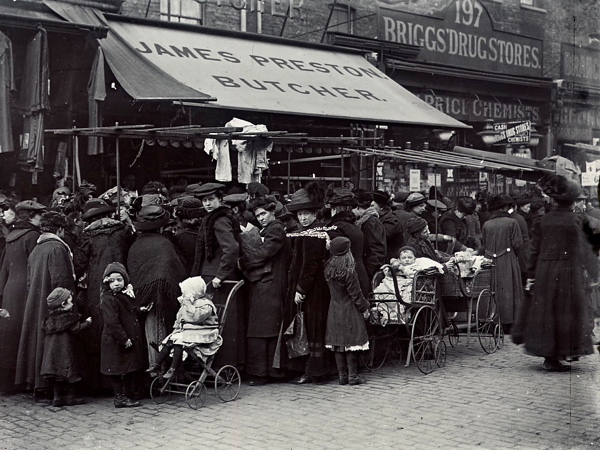
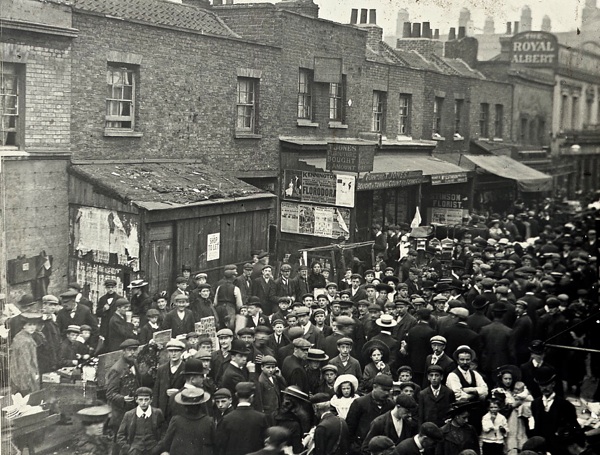
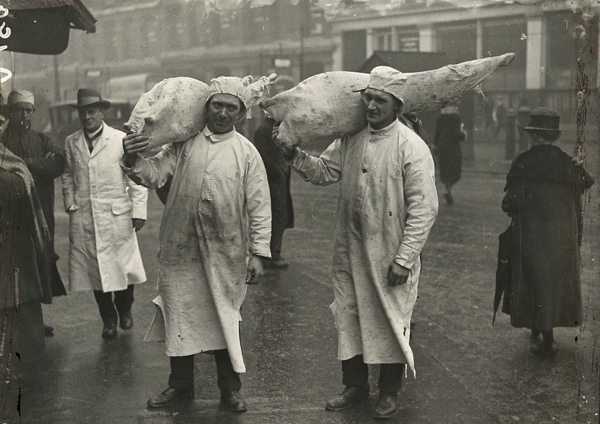
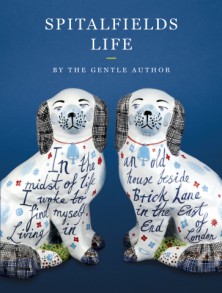
Hoxton Market, Shoreditch, 1910/ East St Market, c.1910/ Porters at Smithfield Market, c.1910. Photographies © Spitalfields Life 2009-12


Broadway Market is located in East-End London, in the Borough of Hackney. Barrow boys have been welcoming shoppers to Broadway market since the 1890s. It is one of London's oldest market located on the ancient drover's road from Essex to the slaughterhouses of Smithfield. This busy food  market dwindled over time until it was limited to a couple of stalls in the early 2000s.  It has been revived on 8 May 2004 when a  food market was launched on Saturdays.  The ongoing development of the area has sparkled a debate about the perceived gentrifiction of Hackney, the greed of some 2012 Olympics game developers and the dubious way a couple of ancient tenants of shops have been evicted from their small premises like Tony Francesca or Spirit. 
"Regeneration sounds like one of those unproblematically good ideas. It is a term you hear a lot from government ministers. One imagines love and attention being poured into a neglected place. But, as Patrick, one of the people who took over Francesca's, puts it, "when local people hear the word, they feel afraid. They feel attacked." The arrival of money into an area always leaves winners and losers, but the more I discover about what has really been happening here, the more I have come to feel angry about the callous way in which the process is being handled. Is this regeneration or degeneration?"
Some people are pessismistic and wonder if landlords will eventually drive the independents out and replace them with franchises.
To know more about the issue, you might be interested by Hari Kunzru's article in The Guardian. I could not find any more recent article on what happened to Tony Francesca's café but I understand from what I read in The voluptuous manifesto that it just disappeared. I would be interested to learn more about it. I am going to investigate further and let you know if I can find something. May be you know better about it? 
The photographs of old markets of London come from a very special blog - which is much more than a blog and has also become a book.  Spitalfields life is signed by the genteel author who tramp the streets of East-end London in search of simple daily life treasures. I have just begun ramaging through it and I cannot but strongly recommend it to you. Next time I will tell you more about Mr Pickleman (photo 4).


8.10.12

A New Frontier Myth. In Search of East End...


Lire et écrire la ville


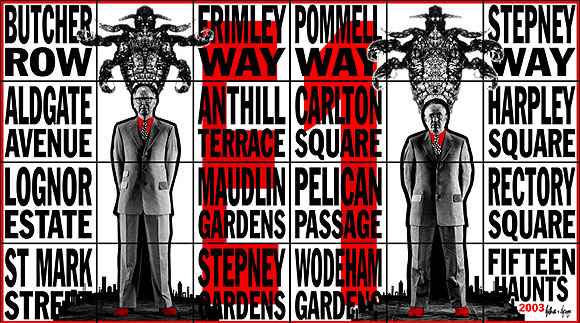
Forty locations, Fifteen haunts and Seventeen streets
  © Gilbert and George, Musée d'art moderne Saint-Etienne, avril 2005 
 All other photos © Jattends


It would not be easy today to find some hopeless conservative using the term East End as a pejorative word, associated with the stigma of poverty, foreign immigration and violence. It is now difficult to imagine how remote the East End of London must have seemed in the late 1960s. "The cultural uptake of the Hoxton scene – as a highly potent image of newness, hipness and fashionability – by the mainstream of not only the art establishment, but the worlds of media, advertising, fashion, design and property development was extraordinarily rapid.(...) In fact, to the social anthropologists at work in advertising agencies and market research offices, the word "Hoxton" was both noun and adjective. This old London district became the latest shorthand to denote what trend analysts have officially described as "urban edgy" – meaning the new, monied, inner-city consumers for whom a knowledge of contemporary art would be right up there with their aspirations for a Thameside loft apartment, a holiday in a hip hotel and their fondness for Pret A Manger sandwiches."
The new bohemia of the British contemporary art scene is now firmly settled in E1. Many artists from the YBA (Young British Artists) live and work in the area. Tracey Emin has her home in Fournier Street, Gilbert and George have been resident there since 1965. "They had been attracted to the East End not simply by the affordability of property – much of it formerly industrial, or almost wholly derelict – but also by the need to declare a barrier of sensibility between themselves and the prevailing cultural climate. "* 
Where is the new barrier of sensibibility and the new frontier to be found now ?


*Michael Bracewell, Gilbert & George - true pionneers of East end art, The Telegraph, 31 mai 2004