3.7.12

Imperfect Lab. Verter Turroni & Emanuela Raveli's Organic Creations


1 Favo modular wall elements design Imperfettolab
2 Mirroe sculptural mirror design Verter Turroni 


3 Mercurio, vitro fib design Imperfettolab

4 Nido fibreglass armchair design Imperfettolab
5 Mercurio in a garden  designed by Xavier Loup
6&7 The designers'home in Marie-claire Maison


"'Imperfetto not as imprecision, but rather as something unique and exclusive, such as the objects in fibreglass that il laboratorio dell’imperfetto designs and produces in its artistic workshop in Gambettola." By creating their own design studio Verter Turroni and his wife Emanuela Ravelli aimed at  finding a synthesis between natural and artificial elements. Their design work is close to sculpture. Each piece is made from a common mould, which is then sanded, painted and hand-polished. They pay exceptional attention to details that derives from an expert and skillful craftsmanship so that each piece acquires identity and uniqueness. Their creations recall the world of nature with their organic shapes and names  such as Bulbi (bulbs), Gusci (shells), Ciottoli (pebbles).  


A voir le reportage de Marie-Claire maison sur leur atelier, un ancien local de ferrailleur reconverti dans la province d'Emilie-Romagne.  


Verter Turroni, Emanuela Raveli and  their children on Pirouette


24.6.12

Beauté et effroi. Damien Hirst's Exhibition at the Tate


“I want art to be life but it never can be.” 


1 The physical Impossibility of Death in the Mind of Someone Living, 1991
  2 A Thousand Years, 1990
3 In and Out of Love (Butterfly Paintings and Ashtrays), 1991
4 'Sympathy in White Major - Absolution II’, detail, 2006
5 The Incomplete Truth, 2006
Photographed by Prudence Cuming Associates © Damien Hirst and Science Ltd. 


"Agony and Extasy" are the feelings you experience while visiting Damien Hirst's first major retrospective at the Tate Gallery. You feel overwhelmed by horror and beauty and knocked down by a carefully crafted sensational impact playing with your nerves. But more deeply you are trapped and you cannot escape thinking about death and the meaning of life. As art historian Rudy Fuchs analysed in Minimal Baroque and Hymns,"Many of the important themes in Hirst’s art, even when they are ambiguously expressed or genuinely puzzling, are religious by nature. Religious references are undeniably part of its idiosyncratic and iconographic atmosphere. I am not suggesting that it is Christian, but the images employed or implied, and the language of the titles, were clearly born out of ecclesiastical and biblical traditions. Death and life, pain and suffering, love and sacrifice, birth and decay, remorse and celebration, compassion: they are not only conditions and emotions central to everyone’s existence, but their relevance and profundity also originate and are shaped, in depth, by our religious and artistic history. Their deep meaning sounds mightily, also for the agnostic, in ‘Paradise Lost’.

Of man's first disobedience, and the fruit

Of that forbidden tree, whose mortal taste
Brought death into the World, and all our woe. 
With loss of Eden..."

Key works from the artist’s most important series are displayed together with one of Hirst’s most iconic works, the ‘Natural History’ piece, ‘The Physical Impossibility of Death in the Mind of Someone Living’ (1991). These include a collection of the ‘Medicine Cabinets’ exhibited at Hirst’s Goldsmiths degree show in 1989 and the seminal fly vitrine, ‘A Thousand Years’ (1990) – considered by the artist to be amongst his most significant pieces. The artist Lucian Freud stated that, with ‘A Thousand Years’ being one of his earliest exhibited pieces, Hirst had perhaps “started with the final act”.


Tate Modern's Damien Hirst exhibition
4 April- 9 September 2012


A lire l'article de l'historien d'art Rudy Fuchs, Minimal Baroque and Hymns


I’ve got an obsession with death … But I think it’s like a celebration of life rather than something morbid. D.H.


The whole smoking thing is like a mini life cycle. For me, the cigarette can stand for life. The packet with its possible cigarettes stands for birth, the lighter can signify God, which gives life to the whole situation, the Ashtray represents death […] being metaphorical is ridiculous, but it’s unavoidable. D.H.


19.6.12

Monde clos. Maria Hofker's Enchanted Garden

A  Paul & Anja 

"Etre seule dans mon jardin.
Dès que j'entre au jardin, le temps disparaît, l'âge ne compte plus. J'ai la certitude que rien de triste ne peut m'y arriver, si ce n'est la difficulté de le quitter".


1 Maria Hofker in her garden. Photography Marÿke Heuff
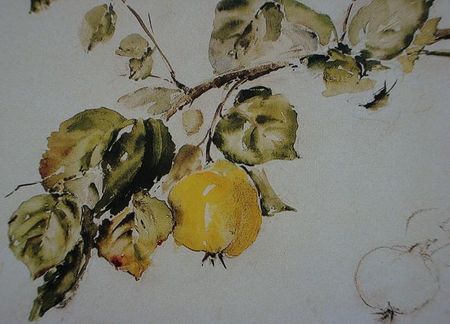
2 Watercolour by Maria Hofker
3 & 4 Georg Rueter's garden In Sloterdijk. 
 Maria Hofker's father taking care of his roses. Photos Uitgeverij Waanders, Drents Museums


La couleur jaune du billet précédent sur le musée Frans Hals et le voyage à Haarlem et Amsterdam m'ont remis en mémoire une personne qui m'a accompagnée très longtemps bien que je n'ai pas eu la chance de la rencontrer dans la vraie vie. J'avais conscience d'habiter pas très loin de son jardin lorsqu' elle s'en occupait encore. Et cette pensée, pour moi emplissait les canaux, la ville entière d'une puissance végétale et bienfaisante. Elle est morte en 1999 et j'ai bien souvent pensé à elle quand j' habitais sur le Herengracht,  que j'arpentais les canaux d'Amsterdam et me perdais dans la verdure de Prinseneiland avec un ami photographe. Un vrai "Amsterdamer" qui connaissait le nom et l'emplacement de chaque arbre de sa ville natale. Qu'importe puisque le monde du  réel est moins fort que le monde de l'imagination; il passe quand les forces de l'esprit demeurent. Maria Hofker a voulu garder la trace de ce passage dans ses aquarelles. Ses carnets disent sa joie et son émotion à contempler son jardin. C'est une parcelle  ordinaire parmi des centaines d'autres, de 16 mètres sur 17 dont elle a fait un jardin sauvage en cultivant des centaines de vivaces et de roses. 


"Autrefois j'aurais souhaité un grand jardin, mais j'ai compris que le bonheur ne vient ni de la dimension, ni de la possession. Avec l'âge qui arrive, je suis ravie de sa taille et le fait de le louer ne change rien. Dès que j'entre au jardin, l'âge disparaît, l'âge ne compte plus. J'ai la certitude que rien de triste ne peut m'y arriver, si ce n'est la difficulté de le quitter". M.H.


The yellow colour of the post on the Frans Hals Museum in Haarlem reminded me of a person I never knew in real life but whose vegetal presence was very dear to me, Maria Hofker. I was very much conscious to live in her neighbourhood when I inhabited a house on Herengracht. Walking around through Amterdam's streets and canals with a true "Amsterdamer" friend, a photographer born in Amsterdam who knew the name and the place of each tree in his beloved city, I felt the fairy presence of the green. Sloterdijk was but only a few metres away "as the crow flies."    
Maria was born in July 1902  in the family house in Sloterdijk. Her father Georg Rueter was an artist - a painter, an illustrator and designer. He also was a very sensitive gardener. He had created an enchanted garden at the back of their house. Unfortunately in 1956, big changes were looming. Due to the city of Amsterdam's  expansion projects, the family  was expropriated. Their heart was broken but they endured uprootedness with dignity and fortitude. Nethertheless Gerarda died in November the same year. Maria Hofker's father and mother  were already aged 85 and 86. 


 5 Willem. G. Hofker, Maria Hofker's husband. Self-portrait, 1935
 6 Petruskerk, Sloterdijk. Engraving by Georg Rueter
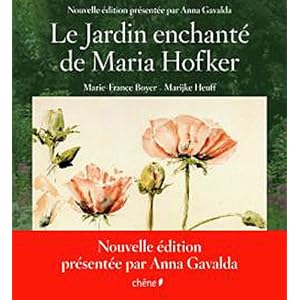
7 Marie-France Boyer, Marÿke  Heuff, Le jardin enchanté de Maria Hofker,  Editions du Chêne, réédition 2009